A Study in Solitude by Iris Origo
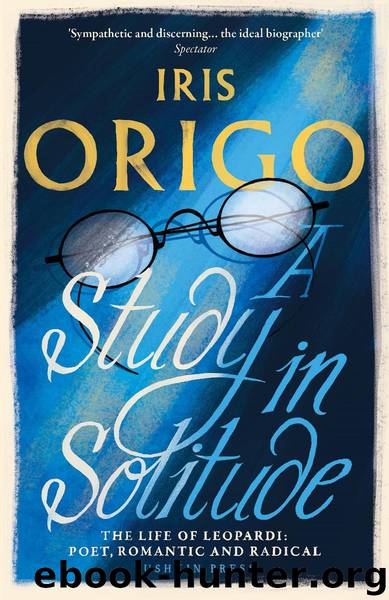
Author:Iris Origo [Iris Origo]
Language: eng
Format: epub
ISBN: 9781782272809
Publisher: Pushkin Press
Published: 2017-03-14T04:00:00+00:00
Their master cries, ‘But how does a man know that he is dead?’ They do not answer. ‘Children, don’t you hear me? The quarter of an hour must have passed. Let’s touch them. They’re dead again, no fear; there’s no danger of their frightening me once more. Let’s go back to bed.’20
In this dialogue, the Chorus of the Dead is a poem as gravely, serenely beautiful as any Leopardi ever wrote. But its theme is a total denial of all life’s values, and the same theme, in varying tones, echoes in the last two Operette, written eight years later; the dialogues Between a Seller of Almanacks and a Passer-by and Between Tristan and a Friend. The first of these is a brief Socratic fable.
‘“Almanacks, new almanacks, new calendars!” “Will the new year be happy?” inquires the passer-by. “Oh, assuredly, your Excellency.” “Happier than the last?” “Oh, much, much more.” “For how many of these years have you sold almanacks?” “For twenty years.” “And which of these twenty years would you wish the coming year to resemble?” “I? I do not know.”’ The obvious conclusion is reached; there is no year of his life to which the seller would wish to return, ‘with all the pleasures and sorrows he knew in it’; he only wants ‘just another year, as God wills to send it, without conditions’. ‘The good life’, comments his hearer, ‘is not life as we know it, but the life we do not know’, and he buys a calendar, ‘the finest that you have got’, for thirty soldi. ‘Thank you, your Excellency, farewell. Almanacks, fresh almanacks! New calendars!’21
And so we come to Tristan—the last of Leopardi’s dialogues, and the saddest. Composed in the summer of 1832, shortly after the end of his last romance, it contains a final rationalization of his own wretchedness, an attempt to convince all men that they are doomed to a misery as deep, as inescapable as his own. The controversial part of the dialogue is marred by an artificial and elaborate irony, but the last pages express, with a grave and moving restraint, the death-wish that had haunted all his life.
‘The fable of life’, Leopardi wrote, was ended for him; he was ripe for death. ‘Books and studies, which I often marvel at myself for having loved so dearly, plans of great deeds, hopes of fame and immortality—all these are things at which it is too late even to smile… I no longer envy the foolish or the wise, the great or the small, the weak or the powerful. I envy the dead, and with them only would I exchange… The memory of the dreams of my youth, and the thought that I have lived in vain, no longer trouble me… If on the one hand there were offered to me, unsullied, the fortune or the fame of Caesar or of Alexander, and on the other, death today—I would say, death today, and take no time in choosing.’22
Download
This site does not store any files on its server. We only index and link to content provided by other sites. Please contact the content providers to delete copyright contents if any and email us, we'll remove relevant links or contents immediately.
Cecilia; Or, Memoirs of an Heiress — Volume 2 by Fanny Burney(31960)
Cecilia; Or, Memoirs of an Heiress — Volume 3 by Fanny Burney(31945)
Fanny Burney by Claire Harman(26607)
We're Going to Need More Wine by Gabrielle Union(19054)
Plagued by Fire by Paul Hendrickson(17417)
All the Missing Girls by Megan Miranda(16052)
Cat's cradle by Kurt Vonnegut(15365)
For the Love of Europe by Rick Steves(14177)
Bombshells: Glamour Girls of a Lifetime by Sullivan Steve(14081)
Leonardo da Vinci by Walter Isaacson(13341)
4 3 2 1: A Novel by Paul Auster(12405)
The remains of the day by Kazuo Ishiguro(9006)
Adultolescence by Gabbie Hanna(8931)
Note to Self by Connor Franta(7673)
Diary of a Player by Brad Paisley(7587)
Giovanni's Room by James Baldwin(7354)
What Does This Button Do? by Bruce Dickinson(6210)
Ego Is the Enemy by Ryan Holiday(5456)
Born a Crime by Trevor Noah(5385)
